Multiple Choice
Identify the
choice that best completes the statement or answers the question.
|
|
|
1.
|
Consider the functions below.
f(x) = x
2
g(x) =
2x
Which has a larger average rate of change from x = 0 to
x = 1 ?
a. | f(x) | b. | g(x) | c. | Neither because they both have an equal
average rate of change over the interval. |
|
|
|
2.
|
A partial set of values of 4 different continuous functions is provided
below. Which function does NOT have a constant average rate of change?
|
|
|
3.
|
The table below shows a set of partial values of two continuous
functions.  Based on any interval from the table which
function always has the larger average rate of change? a. | f(x) | b. | g(x) | c. | Neither because the average rate of change
of both functions is equal over any given interval. |
|
|
|
4.
|
Which function below has the smallest average rate of change from
x = 0 to x = 2 ?
a. | f(x) = ¼•x 2 | b. | g(x) = 5x | c. | h(x) = 2
x |
|
|
|
5.
|
Consider the functions below and
also graphed at the right.
f(x) = x 2
g(x) = 2x – 3
h(x) = x – 4
As  , which function
will eventually have the greatest rate of change? , which function
will eventually have the greatest rate of change? | 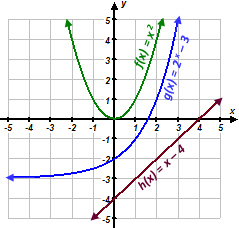 | | |
|
|
|
6.
|
Consider the functions below and
also graphed at the right.
f(x) = x 2 –
2
h(x) = x – 3
Over
which interval below would the two graphs have the same average rate of change? |  | | |
a. | [0,1] | b. | [0,4] | c. | [–2,
2] | d. | [–2, 0] |
|